Grading Scale

Ten grades, four criteria

Our standards are published in full. You can read exactly what we look for before you send us anything.

The RAC scale

Every card receives a whole-number grade from 1 to 10. There are no half grades and no qualifiers.

RAC Grading scale from 10 (Pristine) down to 1 (Damaged)
GradeLabel
10PristineEffectively flawless under close inspection across all four criteria.
9Gem MintOutstanding, with only the faintest imperfection visible under magnification.
8MintExcellent presentation with one or two minor, well-contained flaws.
7Near MintLight handling visible on close inspection, still displaying strongly.
6ExcellentNoticeable but modest wear across one or more criteria.
5Very GoodClear evidence of handling, with the card still structurally sound.
4GoodObvious wear across multiple criteria, presenting as a played card.
3PoorHeavy wear affecting corners, edges and surface together.
2Sub PoorSevere wear, with damage plainly visible at a glance.
1DamagedSignificant structural damage such as creasing, tearing or water exposure.
Criteria

What we assess

Each criterion is judged on its own terms before an overall grade is settled. A card is only as strong as its weakest category.

Centering

How evenly the printed image sits within the card borders, measured on both the front and the back. Our centering thresholds mirror standard industry practice.

10
Front approximately 55/45 or better; back approximately 75/25 or better.
9
Front approximately 60/40 to 65/35; back approximately 90/10 or better.
8
Front approximately 70/30; back within reasonable tolerance.
7 and below
Increasing off-centre tolerance as the grade decreases.

Corners

The sharpness and integrity of all four corners, assessed both to the naked eye and under magnification.

10
All four corners perfectly sharp under close inspection — no whitening, softness or wear of any kind.
9
Corners appear sharp to the naked eye; only the faintest touch of wear visible under magnification.
8
Minor softness or the slightest hint of wear on one or more corners, still tight overall.
7 and below
Visible rounding, fraying or whitening, increasing as the grade decreases.

Edges

The condition of all four edges, covering chipping, nicks, roughness and colour break.

10
Clean, unbroken edges on all four sides — no chipping, nicks or roughness anywhere.
9
Edges essentially clean, with only the most minor imperfection detectable under close inspection.
8
Slight roughness or a small nick along an edge, not affecting overall presentation.
7 and below
Increasing edge wear, chipping or whitening.

Surface

The card face and back, covering scratches, print lines, indentations, factory defects and gloss retention.

10
Flawless surface — no scratches, print lines, indentations or factory defects; full original gloss.
9
Near-flawless, with only an extremely minor and hard-to-spot imperfection such as a faint line or tiny surface mark.
8
A small scratch, minor print imperfection or slight gloss inconsistency visible on inspection.
7 and below
Increasingly visible scratches, indentations, print defects or gloss loss.
Examples

What each band looks like

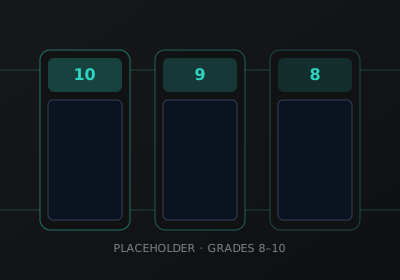
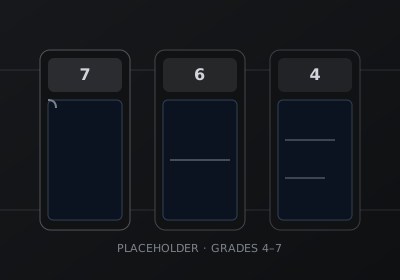
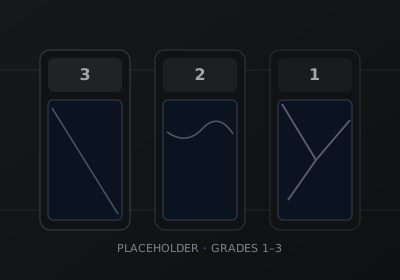
Grades group naturally into three bands. Real example photography for each grade is on the way.

  • Three graded card outlines side by side showing grades 10, 9 and 8, with clean sharp corners and edges

    Grades 8–10

    Cards in this band present as effectively unplayed. The difference between an 8 and a 10 is often only visible under magnification.

  • Three graded card outlines showing grades 7, 6 and 4, with softened corners and light surface lines

    Grades 4–7

    Light to moderate handling becomes visible to the naked eye — softened corners, minor edge wear, or a surface mark.

  • Three graded card outlines showing grades 3, 2 and 1, with visible creasing and heavy surface damage

    Grades 1–3

    Heavy wear or structural damage. These cards are authenticated and encapsulated with exactly the same care as any other submission.